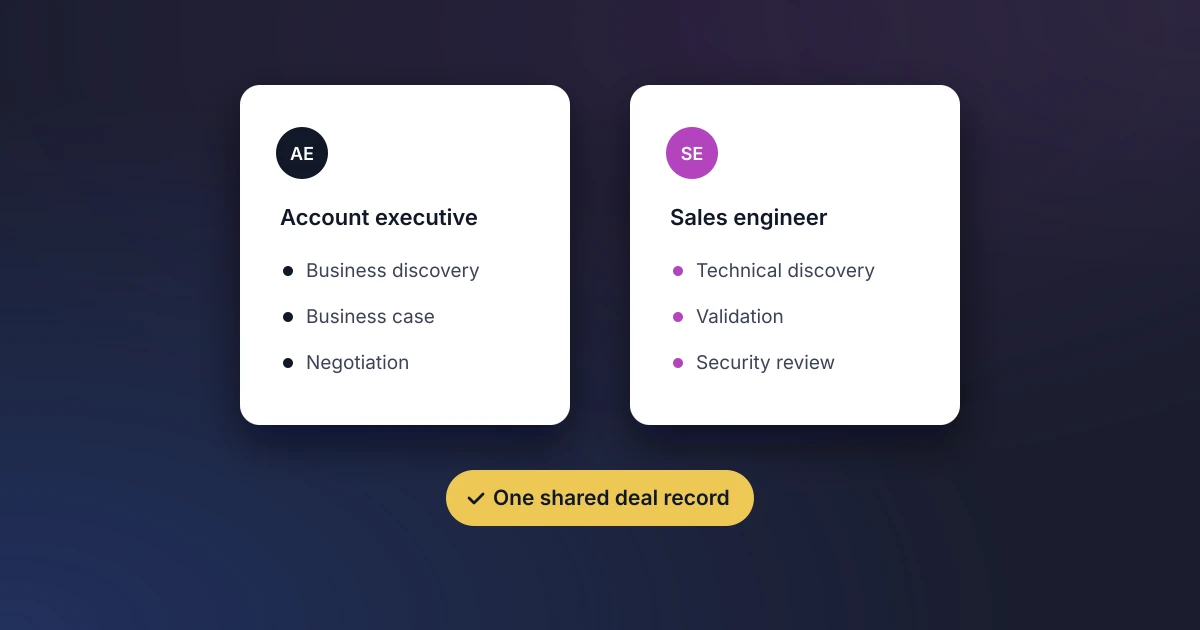
Sales and PreSales collaboration works when both teams agree who owns what at each deal stage, when a sales engineer gets involved, and where deal information lives. Most friction between account executives and sales engineers comes from leaving those three things unwritten, not from personalities.
The relationship has changed. As PreSales Collective puts it, selling is now much more a partnership between SEs and AEs than a handoff. When that partnership is weak, communication breaks down, deals feel chaotic and good people leave.
This playbook covers why collaboration breaks down, a stage-by-stage ownership table, rules of engagement you can adopt this quarter, how to choose an engagement model, and how to measure whether it is working.
Why Does Sales and PreSales Collaboration Break Down?
The same six problems come up in most teams:
- Unclear ownership. Nobody has agreed who runs discovery, who owns the business case or who decides when a POC is justified.
- The SE arrives too late. The sales engineer is pulled in for a demo after the requirements, and sometimes the promises, have already been set.
- Unqualified requests. SE time goes on demos for deals that were never going to close, leaving less for the ones that will.
- Two versions of the deal. The AE’s view lives in the CRM, while the SE’s notes live in documents, Slack threads or a separate tool.
- Different scorecards. AEs are measured on revenue and SEs on activity, so each side optimizes for something the other cannot see.
- Not enough SE capacity. Consensus found 70% of deals need PreSales support, and its research suggests one SE can sustainably support only three to four AEs. When Sales hires faster than PreSales, every other problem on this list gets worse.
Who Owns What at Each Deal Stage?
Write this down and agree it with Sales leadership. The exact split varies by company, but every stage needs one clear lead.
| Deal stage | Account executive | Sales engineer |
|---|---|---|
| Qualification | Leads: confirms pain, budget and timing | Advises on technical fit when asked |
| Discovery | Leads business discovery | Leads technical discovery and drafts technical criteria |
| Demo | Frames the business story and next steps | Leads the tailored demo |
| Technical validation and POC | Keeps the economic buyer engaged | Leads: agrees success criteria and runs the evaluation |
| Security and IT review | Manages timeline and stakeholders | Leads questionnaires and architecture questions |
| Business case and proposal | Leads | Supplies technical scope and value evidence |
| Negotiation and close | Leads | Informed, joins if technical terms arise |
| Handover to delivery | Introduces the customer team | Hands over requirements, risks and commitments |
The stage that matters most is technical validation. Its outcome, the technical win, is the point where the SE’s work becomes visible to the rest of the revenue team, so it should have a clear owner and a clear definition.
Set Rules of Engagement
Rules of engagement turn good intentions into a process both sides can follow. Who owns what, how success is measured and where conflicts go are the questions PreSales practitioners consistently raise, for example in this PreSales Collective session with sellers and SEs. A workable set covers six points:
- An entry gate. Agree the minimum an opportunity needs before an SE joins, such as confirmed pain, a named technical stakeholder and a defined next step.
- A standard request. Every SE request states the account, deal stage, attendees, goal of the meeting and what the buyer has already seen.
- A lead time. Agree how much notice a standard demo and a custom demo need, so preparation is planned rather than rushed.
- Roles on the call. Decide before each meeting who opens, who handles pricing and who answers technical questions, so the buyer sees one team.
- A debrief. After every customer meeting, both update the Opportunity with what was learned, open risks and the next step.
- An escalation path. Disagreements about priority or SE time go to the Sales and PreSales managers together, not to whoever shouts loudest.
Choose an Engagement Model: Direct, Pooled or Hybrid
Whether SEs should be aligned directly to account executives or assigned from a shared pool is a long-running debate among PreSales leaders, and a regular PreSales Leadership Collective roundtable topic. Each model suits a different motion:
| Model | How it works | Strengths | Watch out for |
|---|---|---|---|
| Direct alignment | Each SE supports a fixed group of AEs or accounts | Continuity, deep account knowledge, strong working relationships | Uneven workload when one AE’s pipeline spikes |
| Pooled | SEs are assigned to deals from a shared queue | Flexible capacity, specialists matched to deal needs | Less continuity for buyers, weaker AE and SE relationships |
| Hybrid | Direct alignment for larger deals, pooled for smaller ones | Matches SE investment to deal size | Needs clear rules on which deals qualify for each |
Whichever model you choose, the rules of engagement above still apply. A pooled model without an entry gate fills up with unqualified demos, and a direct model without debriefs still leaves the SE’s knowledge outside the CRM.
Visibility of SE capacity matters as much as the model you pick. In a McKinsey case study (first published in 2015), a company found its technical experts were not being assigned to its highest-value bids. Once leaders could see PreSales availability and skills a quarter ahead, it staffed 15% more deals with the same team and halved the time sales reps spent on proposals.
Run Joint Deal Reviews
A short weekly review of active opportunities, attended by the AE, the SE and their managers, keeps both sides working from the same picture. Keep the agenda tight:
- Where is the technical evaluation, and what is still unproven?
- Which technical or commercial risks are open, and who owns each one?
- What is the next customer meeting, and who needs to be in it?
- Should this deal still get SE time this week?
The last question matters most. Deal reviews are where both teams agree to stop investing in a deal that has gone quiet, which protects SE capacity for the opportunities that can still be won.
Keep One Record of the Deal
Collaboration fails quietly when the SE’s knowledge sits outside the CRM. If technical requirements, risks and product gaps live in documents or chat threads, the AE cannot see them, the forecast ignores them and they disappear when the SE moves on. Put them on the Opportunity record, in structured fields, so the AE, the sales manager and the CRO all read the same deal.
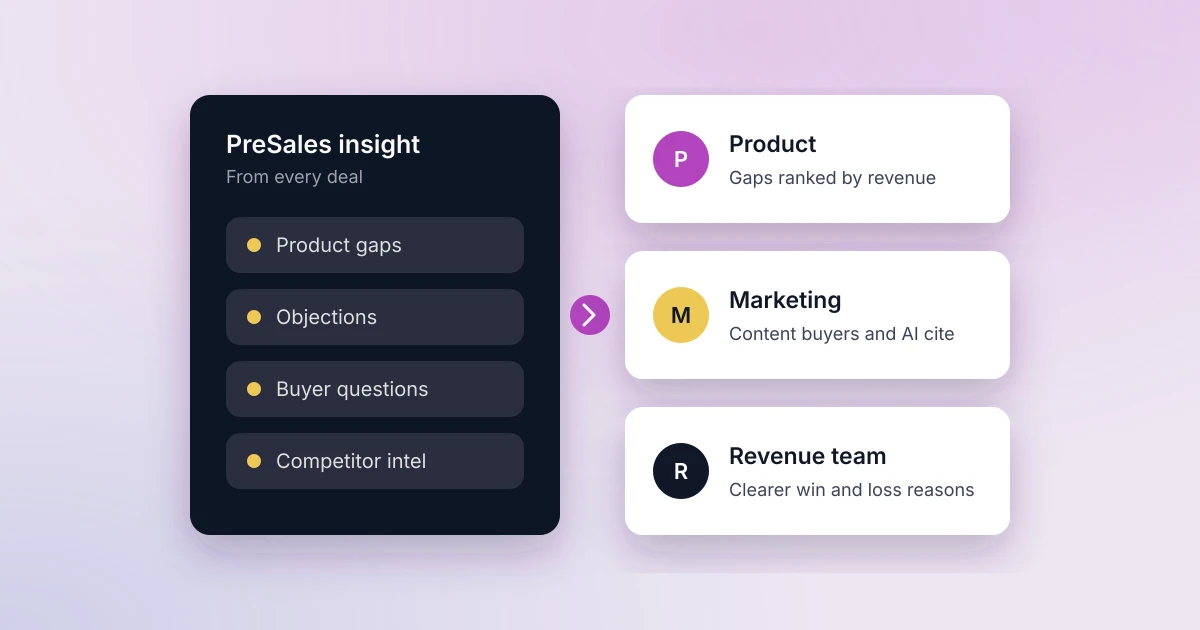
Product gaps deserve the same treatment. Every “we don’t do that yet” in a sales cycle is product feedback with revenue attached. Log each gap against the Opportunity, link it to the product backlog, and report the pipeline value it affects. The AE gets an honest answer to give the buyer, and the product team gets evidence instead of anecdotes.
One shared record matters more as buyers research on their own and arrive with sharper technical questions. Gartner found that 69% of B2B buyers turn to sales reps to validate AI-generated insights, so AEs need the SE’s technical context to hand, not just when the SE is on the call.
How Do You Measure Sales and PreSales Collaboration?
Pick a few shared metrics that both teams can see and influence:
- Win rate with and without SE involvement: shows where SE time changes outcomes.
- Stage of first SE involvement: shows whether SEs are joining at discovery or only at the demo.
- Technical win rate and technical win to close rate: separate technical outcomes from commercial ones. Our technical win guide explains how to calculate both.
- SE hours on won versus lost deals: shows whether capacity is going to the right opportunities.
Review them together each quarter. If the numbers are only ever presented by one side, they become a defense rather than a shared plan.
The partnership does not end when the contract is signed. Our PreSales and customer success playbook covers the other half of the lifecycle: handovers, post-sale SE time and land and expand.
Where Elvance Fits
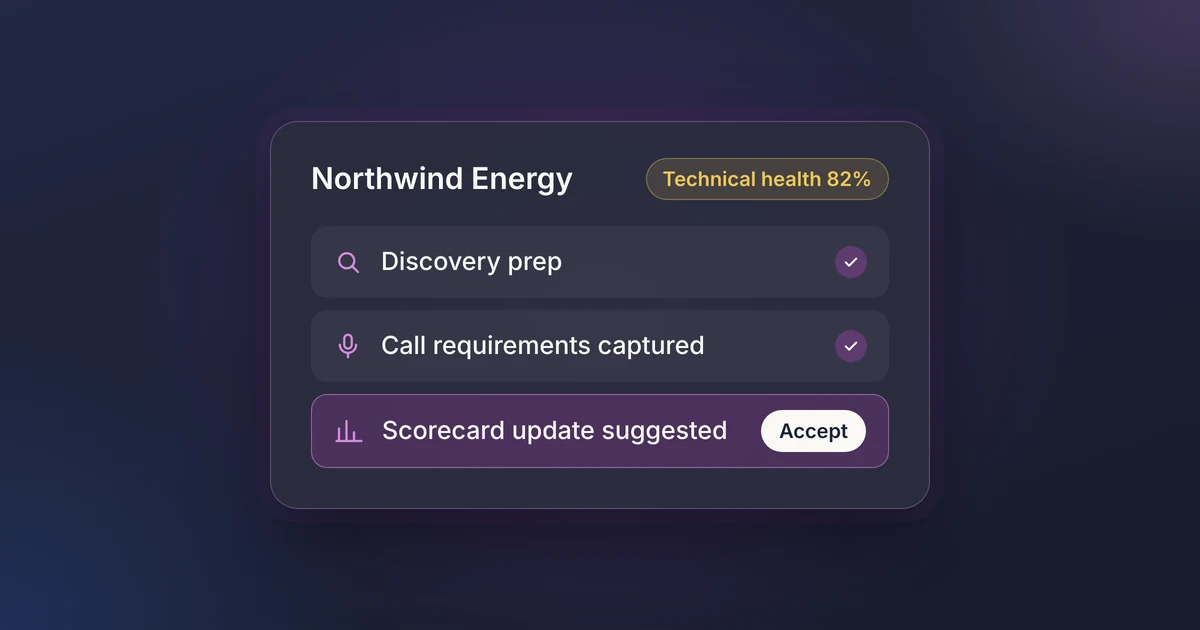
Elvance is the AI PreSales platform built inside Salesforce, so Sales and PreSales work from the same Opportunity record. AI technical scorecards show the AE exactly where the technical evaluation stands, risks are tracked to resolution, and calendar sync with Google and Outlook logs SE activity against the right opportunity automatically. Because the data is native to Salesforce, the shared metrics above work in standard reports and dashboards, with no separate system for either team to check.
Frequently Asked Questions
When should a sales engineer join a deal?
As soon as an opportunity passes your agreed entry gate, ideally in time for technical discovery. Joining at discovery lets the SE shape the technical criteria instead of reacting to them at the demo.
Should sales engineers be paired one to one with account executives?
It depends on deal size and volume. Direct alignment builds continuity on larger, complex deals, while a pooled or hybrid model spreads SE capacity better across high volumes of smaller deals.
How do you resolve conflicts between Sales and PreSales?
Agree an escalation path in advance. The AE and SE raise it with both managers together, who decide using the shared deal data rather than opinion. Most recurring conflicts point to a gap in the rules of engagement, so fix the rule as well as the deal.
What is a good AE to SE ratio?
There is no single right number. Consensus research puts the average at around four AEs per SE and suggests three to four is likely the sustainable limit, while the NAASE 2025 survey found the most common setup was two to three AEs per SE. The right ratio depends on deal complexity, deal volume and how much of each deal needs an SE.
See how Sales and PreSales share one Opportunity record in Salesforce: book a demo.