The biggest PreSales trends for 2026 point the same way: buyers want proof, and AI is changing how teams deliver it. Most buyers would rather research without a seller, buying groups are large, and AI agents are moving into everyday sales tools. For PreSales leaders, that means more pressure to show impact with data and less room for guesswork.
Below are six shifts to plan for this year, what is driving each one, and how your team can respond.
1. Buyers Would Rather Research Without a Seller
In June 2025, Gartner reported that 61% of B2B buyers prefer an overall rep-free buying experience. The same survey found that 69% of buyers see inconsistencies between what a supplier’s website says and what its sellers tell them.
As a result, the moments when a buyer does speak to a sales engineer carry more weight. A generic demo wastes a rare opportunity. Instead, SEs need to act as advisors who answer the questions a website cannot, and their technical story has to match what the buyer has already read.
How to respond: review your technical messaging against your website, prepare for each call with what the buyer has already seen, and record what you learn in Salesforce so the next conversation builds on it.
2. Buying Groups Are Large, and Procurement Is in the Room
Forrester’s State of Business Buying, 2026, published in January, found that a typical purchase involves 13 internal stakeholders and nine external influencers. Moreover, procurement acts as a decision-maker in 53% of buying cycles.
For PreSales, more stakeholders means more technical evaluators, more security reviews and more people to convince. Consequently, requirements and risks spread across emails, call notes and spreadsheets, and the deal team loses sight of where the opportunity really stands.
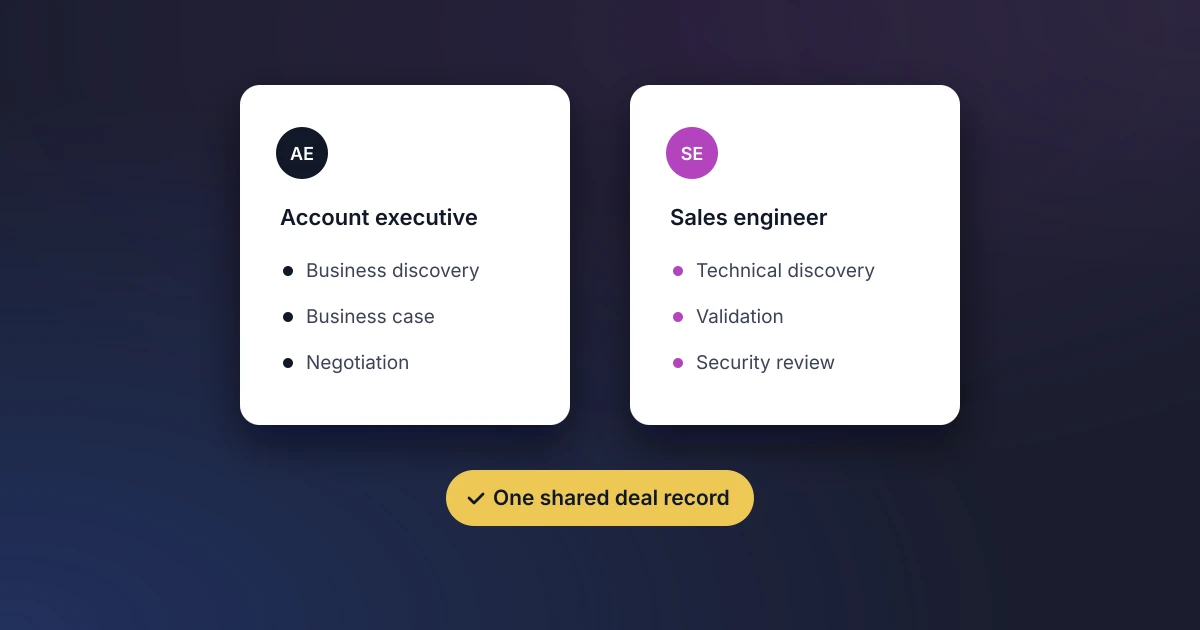
How to respond: map the technical stakeholders on every major opportunity, and keep requirements, risks and next steps in one shared place on the Opportunity record. That way, Sales and PreSales work from the same picture. Our guide to collaboration between Sales and PreSales teams covers the basics.
3. Proof Beats Promises
The same Forrester research shows that more than 60% of business buyers use a trial before they buy. For purchases of $10 million or more, that rises to 78%. In other words, trials and proofs of concept are now a standard part of the buying process, not an exception.
Trials are expensive in SE time, however. Without clear qualification, teams commit weeks to evaluations that were never likely to close.
How to respond: qualify trials before you commit resources, agree success criteria with the buyer up front, and record the outcome of every evaluation. Over time, that data shows which trials convert and which ones drain capacity.
4. AI Agents Move Into Sales Tools
Gartner predicts that 40% of enterprise applications will include task-specific AI agents by the end of 2026, up from less than 5% in 2025. Looking further ahead, Gartner also expects AI agents to outnumber human sellers tenfold by 2028.
Access to AI will not be the hard part, though. Gartner expects fewer than 40% of sellers to say AI agents have improved their productivity by 2028. Similarly, it predicts that more than 40% of agentic AI projects will be canceled by the end of 2027 because of escalating costs and unclear business value.
How to respond: start with narrow, repetitive PreSales tasks where success is easy to measure, such as logging activity or turning meeting notes into CRM updates. Then set a clear goal for each pilot, track the time it saves, and scale only what works.
5. Open Standards Connect AI to Your CRM
In 2025, the Model Context Protocol (MCP) became a common way to connect AI assistants to business systems. In June, Salesforce announced Agentforce 3 with built-in support for MCP. Then, in December, Anthropic donated MCP to the new Agentic AI Foundation under the Linux Foundation, co-founded with Block and OpenAI. At that point, the project reported more than 97 million monthly SDK downloads and 10,000 active servers.
For PreSales teams on Salesforce, this matters because AI assistants can increasingly reach CRM data directly. However, an assistant can only be as useful as the data it reaches. If PreSales activity, requirements and risks live outside Salesforce, AI cannot use them.
How to respond: keep PreSales data structured and inside Salesforce, and agree governance with your Salesforce admins and security team before you connect any AI tool.
6. PreSales Must Prove Its Impact
Consensus’s 2025 Sales Engineering Compensation and Workload Report, based on more than 600 PreSales professionals, found that 70% of sales deals require PreSales support. At the same time, Forrester describes buyers under heavy pressure to justify every investment, and that scrutiny applies inside your business too.
Therefore, when PreSales touches most deals, leaders need data that shows where SE time goes and what it delivers. Gartner’s advice to sales leaders points the same way: make sure data is accurate before scaling AI, and measure both human and AI contributions.
How to respond: track a small set of PreSales metrics consistently, such as technical win rate, revenue influenced, team capacity and the revenue at risk from product gaps. Capturing activity automatically helps here, because it removes the manual logging that SEs skip. Read more about intelligent activity capture.
What Should PreSales Leaders Prioritize in 2026?
- Make every SE conversation count, because most buyers would rather research on their own.
- Keep one shared view of each deal, so large buying groups get a consistent answer.
- Qualify trials early, and record their outcomes.
- Pilot AI on specific tasks, with clear goals and measured results.
- Keep PreSales data in Salesforce, where Sales, leadership and AI tools can use it.
- Measure impact, so you can show the value of PreSales and plan capacity.
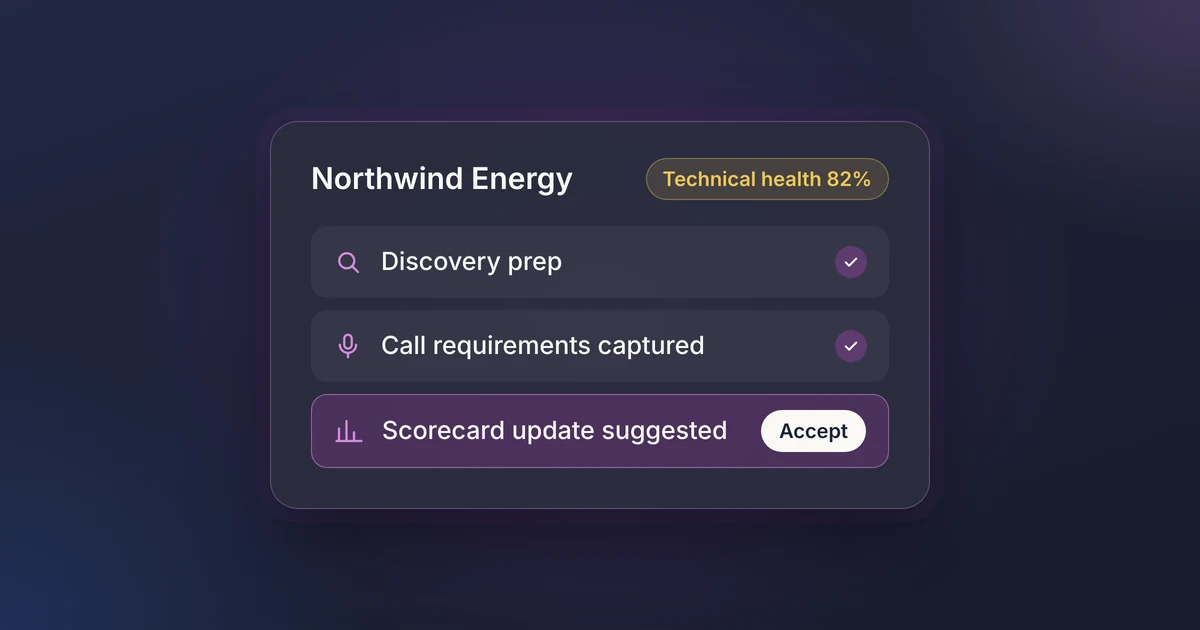
Elvance helps PreSales teams do this natively in Salesforce, with technical scorecards, activity capture, product gap tracking and reporting on the Opportunity records your teams already use. Ready to see it? Book a demo.
Sources
- Gartner, Sales Survey Finds 61% of B2B Buyers Prefer a Rep-Free Buying Experience, June 2025
- Gartner, Predicts Over 40% of Agentic AI Projects Will Be Canceled by End of 2027, June 2025
- Salesforce, Salesforce Launches Agentforce 3, June 2025
- Gartner, Predicts 40% of Enterprise Apps Will Feature Task-Specific AI Agents by 2026, August 2025
- Consensus, 2025 Sales Engineering Compensation and Workload Report, October 2025
- Gartner, Predicts by 2028 AI Agents Will Outnumber Sellers by 10x, November 2025
- Model Context Protocol, MCP Joins the Agentic AI Foundation, December 2025
- Forrester, The State of Business Buying, 2026, January 2026