
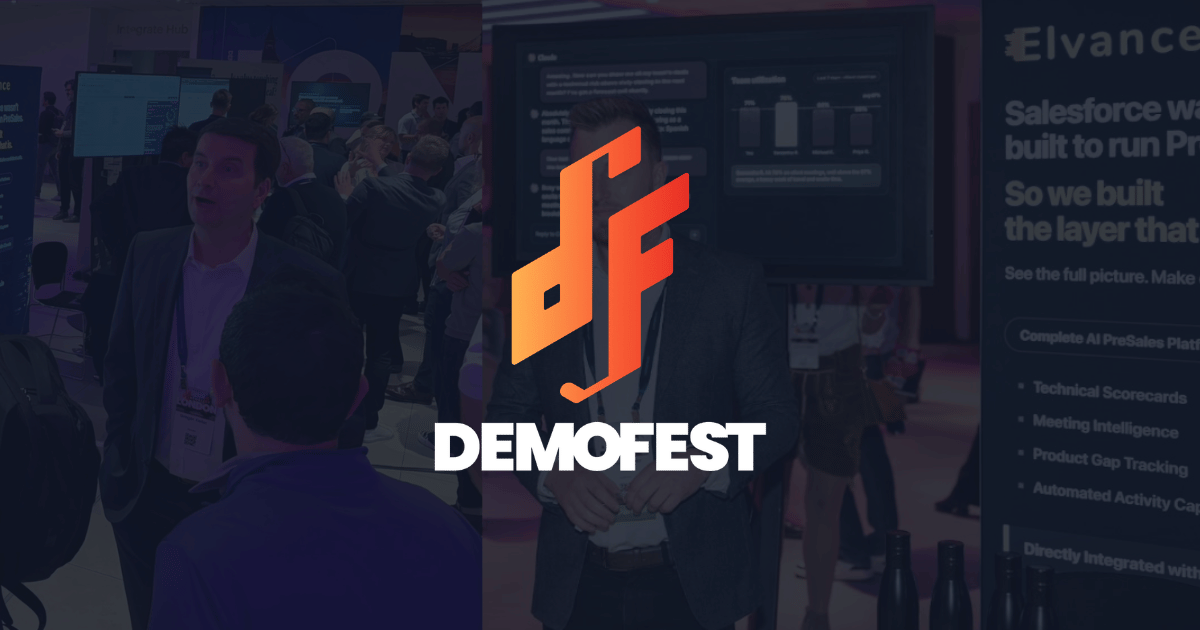
On 14 October, the London PreSales community filled Convene, 133 Houndsditch for DEMOFEST London 2026, the buyer enablement conference run by Consensus. Elvance was there as an event partner. Across keynotes and panels, the agenda kept circling one tension: buyers want less of a seller’s time, while PreSales teams have less time to give.
This recap covers the five challenges that came up most, the research behind each one, and what PreSales leaders can do before 2027 plans lock.
What was DEMOFEST London 2026 about?
DEMOFEST London 2026 was a one-day conference for PreSales, solution consulting and go-to-market leaders, held on 14 October 2026 in the City of London. The agenda ran from agentic selling and discovery to leading PreSales teams through AI and proving PreSales revenue impact.
The opening panel on agentic selling brought together PreSales and GTM leaders from HubSpot, Google Workspace, Sage and Featurespace. Later sessions came from practitioners at Oracle, Gong, Ontic, Trintech, Accruent and Planview, alongside SE Rockstars and Alpha Presales. Consensus also used its opening keynote to launch a new brand and product strategy built around the demo as a continuous buying experience.
What are the biggest PreSales challenges right now?
Five challenges dominated the day: buyers who self-serve but still want validation, squeezed discovery, SE capacity, proving PreSales impact, and AI gains that are real but modest.
1. Buyers go it alone, then come back to validate
A Gartner survey of 646 B2B buyers, fielded August to September 2025, found 67% prefer a rep-free experience and 45% used AI during a recent purchase. Yet Gartner’s follow-up release found 69% prefer to validate AI-generated insights with a sales rep.
The agentic selling panel and Gong’s session on reinventing the SE role pointed the same way. When buyers arrive pre-researched, the SE’s value shifts from showing the product to helping buyers judge what genuinely matters for their business.
2. Discovery is getting squeezed out
Alpha Presales tackled a familiar problem: running discovery when the prospect only wants a demo. The organiser’s own 2026 SE Compensation and Workload Report (423 PreSales professionals, April 2026) puts numbers on it. Nearly 37% of demos go to unqualified or under-qualified leads, and about 73% of teams do only minimal or informal discovery first.
The irony: 34% of respondents named discovery as the single activity that most improves outcomes.
3. SE capacity is stretched thin
The same report found SEs spend only 56% of their time on direct sales work. The other 44% goes on cross-functional tasks such as implementation support, marketing and product collaboration. Just 12% reported no burnout symptoms, down from 20% in 2025, and many experienced SEs describe 55 to 60+ hour weeks.
Ontic’s human-first leadership session made the case that preparing teams for AI is a people question before it is a tooling question. Our view: capacity is a visibility problem first. You cannot rebalance SE time you cannot see.
4. Proving PreSales impact to the CRO
SE Rockstars framed PreSales performance as a chain: SE behaviours drive leading metrics, which drive the lagging KPIs boards watch, namely win rate, deal size and sales cycle length. Trintech’s session made the related case for PreSales as a growth engine rather than a cost line.
The pressure is real. In the Consensus report, closed revenue or ARR is the most common PreSales KPI (78%), ahead of demo or POC activity (54%) and sales feedback (53%), with technical wins trailing. Our view: the technical win is the leading indicator most teams under-use, because it rarely lives where the CRO looks: on the Opportunity record.
5. AI is helping, but not yet transforming
88% of SEs in the Consensus report see some productivity gain from AI, but about 73% call it slight or moderate, and only 15% call it significant or transformational. A third of teams (32%) automate no part of the demo process.
The pattern is AI layered onto manual workflows. 2Win!’s session on a hybrid human and agent workforce, trained on one shared methodology, pointed to a different model. Our view: AI is only as useful as the process and data underneath it.
How can PreSales leaders act on this before 2027 planning?
Start with visibility, then standards, then tooling. A six-point checklist:
- Map where SE time goes. Split direct deal work from cross-functional work, per person, for one quarter.
- Set a discovery minimum. Agree two or three qualifying questions that must be answered and logged before any custom demo.
- Define the technical win. Agree what counts, and record it on the Opportunity so it can sit next to win rate.
- Pick three leading indicators for the CRO. For example: technical win rate, SE coverage of pipeline, and time from first meeting to technical win. Report them monthly.
- Check the data before adding AI. Are activities, technical signals and product gaps captured consistently on the record AI will read?
- Coach SEs as validators. Prepare them for the “is this right for us?” conversation, not just the walkthrough.
Where does Elvance fit?
Elvance is a PreSales platform that runs natively in Salesforce, so this work happens on the Opportunity record your CRO already reports from. Intelligent Activity Capture logs meetings and demos against the right opportunity and shows SE capacity. AI Technical Scorecards capture requirements and technical signals per deal, and product gap tracking links missing features to live pipeline. With the Elvance connector for Claude, leaders can ask about pipeline risk in plain language.
See it in action: watch the Elvance demo videos.